
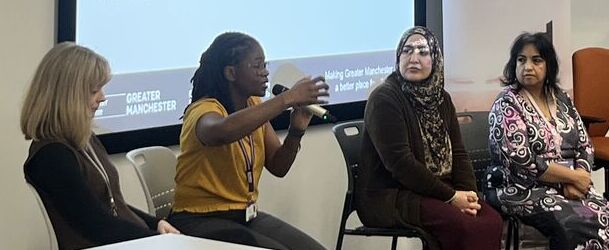
Seminar explores how policymakers can support ethnic minority women experiencing domestic abuse
The seminar featured presentations from Dr Omolade Allen, Senior Lecturer in Global Health Research; Kate Smith, Gender-Based Violence and Victims Principal at the Greater Manchester Combined Authority; and Rizwana Baleem and Nagina Ahmed, practitioners from Rochdale Women’s Welfare Association.
The University of Manchester’s GM Policy Hub used its first seminar of the 2026-2027 academic year to highlight research by Dr Omolade Allen, which explores the role that faith communities can play in supporting women ethnic minority survivors of domestic abuse and preventing gender based violence (GBV).
The seminar featured a presentation from Kate Smith, Gender-Based Violence and Victims Principal at the Greater Manchester Combined Authority (GMCA), who outlined work that was going on across Greater Manchester to support victims and prevent GBV.
Rizwana Baleem and Nagina Ahmed, practitioners from Rochdale Women’s Welfare Association highlighted their experiences working on the frontline to support women, and how this interacts with policymakers.
Dr Omolade Allen, Senior Lecturer in Global Health Research
Dr Allen’s research is based on interviews with 15 ethnic minority women who have experienced domestic violence (DV). She found that ethnic minority women experience additional barriers due to racism, discrimination, cultural expectations and a mistrust of statutory services. Many ethnic minority women who experience DV have no recourse to public funds or access to public services due to their immigration status.
They tended to “go to spaces where they have the social structures. There is help there that helps them get access to statutory and specialist domestic abuse services.” For many ethnic minority women, these spaces are faith-based organisations.
Faith based-organisations represent a unique opportunity for accessing support. The participants in Dr Allen’s study treated faith leaders as a first point of disclosure before police, healthcare, social or mental health services. For women unable to access public services, faith-based organisations often include a large number of members who are also professionals who can provide direct support. Study participants described faith spaces as “sources of encouragement, solidarity and emotional survival” including sign-posting to other sources of support.
However faith spaces have a “complex and conflicting role”, where “some women received advice focused on reconciliation, endurance, preserving marriage/intimate relationship.” This led to delays in seeking help, which prolonged abuse, worsened mental health outcomes and isolated the victim from support systems. Many faith leaders acknowledge they need more training, especially in formal safeguarding, the referral systems, and statutory pathways.
Dr Allen noted that faith-based organisations already function as frontline responders, but are underutilised in domestic abuse strategies. Faith-based organisations should not replace statutory services, but they should become a trusted gateway to them. Dr Allen closed by saying that “faith communities already have a role in responding to domestic abuse. The next step is strengthening that role safely.”
Kate Smith, Gender-Based Violence and Victims Principal, Greater Manchester Combined Authority
Kate Smith discussed how policymakers can work with faith-based organisations to support survivors of domestic abuse, and outlined some of the GMCA’s current pieces of work.
Greater Manchester’s Gender Based Violence (GBV) Strategy recognises that GBV does not exclusively impact women and girls, however women and girls are exposed to higher risk. The strategy is informed by research, engagement and consultation, including with lived experience. Its delivery focuses on prevention and coordinating responses across the region.
Over the period 2026 to 2029, the GMCA is looking to build on its existing work. This will include:
- working with the ten GM boroughs who have existing partnerships and relationships with VCFSE organisations;
- continued support for those with no recourse to public funds fleeing abuse;
- commissioning specialist support from “By and For Organisations”;
- improve support pathways across all forms of GBV, through better understanding of intersectionality;
- prioritise support for victims of honour based abuse and harmful practices.
Kate Smith said the GMCA has a “range of recent projects, including one around victims who have chosen not to report it to the police. Not surprisingly, a lot of those are in faith based organisations.” She continued “As Omolade has said, as we all know in this room, in addition to the challenges survivors face, there are all these other additional barriers, immigration status, language barrier.”
Rizwana Baleem and Nagina Ahmed, practitioners from Rochdale Women’s Welfare Association
Rochdale Women's welfare supports survivors of domestic abuse. They offer counselling, wellbeing services, and “continue to provide support after the acute phase”. Their classes include topics ranging from maths and sewing to longterm health conditions. This helps to prevent isolation, which is particularly important as some of their service users have experienced abuse for decades.
They compared the support they offer to statutory services, where counselling lasts for six weeks and the wait lists are currently over two years. Baleem pointed out that they will provide support as long as needed, with some having counselling for 22 weeks.
Rizwana Baleem highlighted that “funds are drying up, we are getting less funding now than we used to. From March, we are looking at reducing services, helping fewer women”. They echoed the challenges faced by women with no recourse to public funds, who won’t be accepted by women’s refuges.
Nagina Ahmed highlighted that they had been able to enter faith-based organisations in Rochdale to support faith leaders to combat DV, and now they have had referrals from those same organisations.
To see the complete list of GM Policy Hub seminars, these are available on Policy@Manchester's website.